
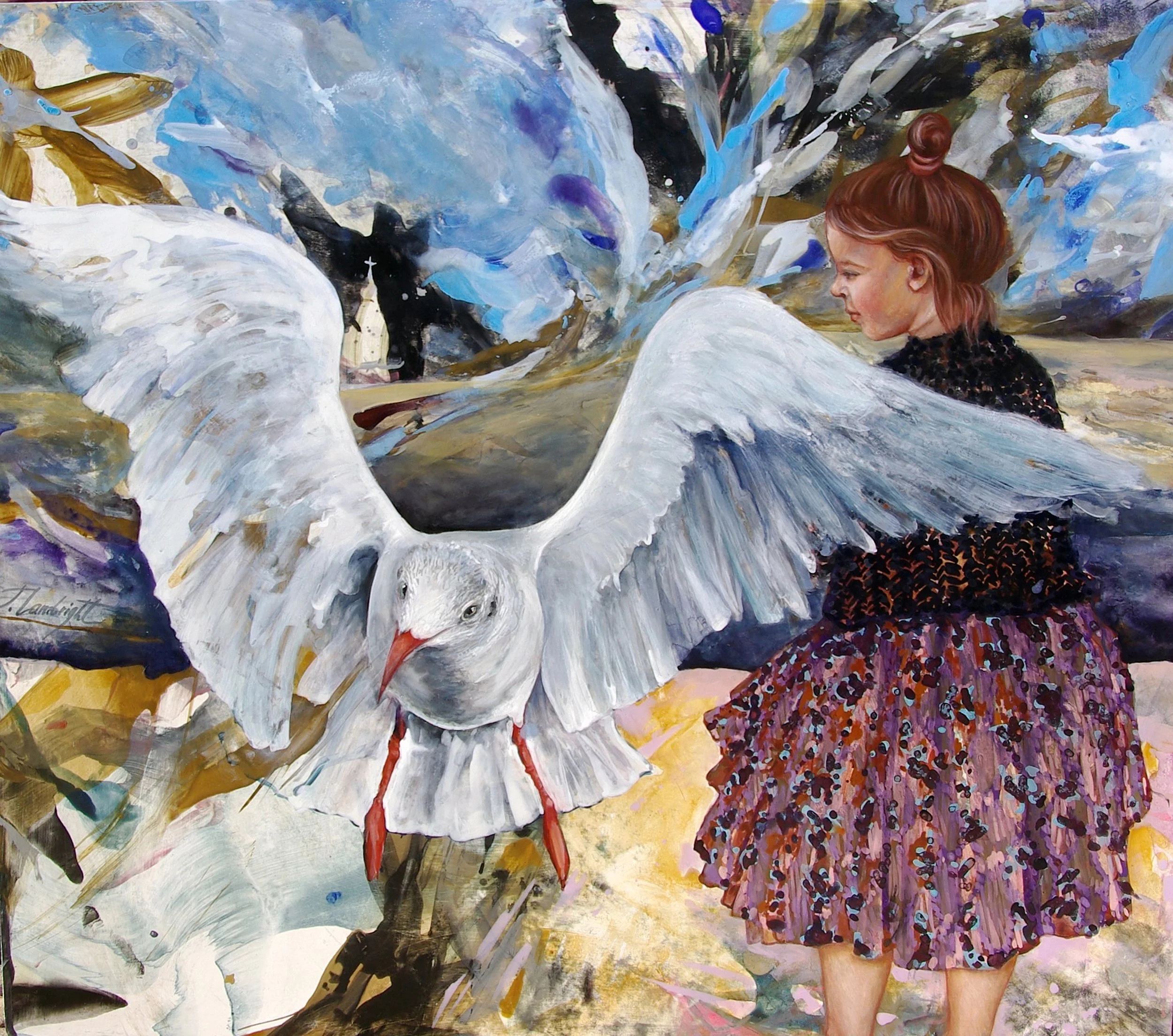
Julia Labright, She Must Fly, 2925, egg tempera on panel
Julia Lambright’s She Must Fly (2025) is a deeply personal painting that brings together biography, memory, and material in a way that feels both intimate and expansive. Born in Russia and placed in an orphanage as an infant, Lambright has lived with the lasting effects of early trauma. Rather than illustrating those experiences directly, she works through them symbolically, using painting as a space for reckoning, transformation, and release.
At the center of She Must Fly is a young girl, turned slightly away, paired with a bird whose wings are fully extended, caught in the moment just before flight. The image reads as both tender and urgent. The child suggests vulnerability and longing, while the bird embodies motion, possibility, and escape. Together, they form a quiet narrative of a girl who wants, and needs, to leave something behind. The title reinforces this sense of necessity. Flight here is not a fantasy but an imperative.
Lambright’s choice of egg tempera is central to the emotional and visual power of the work. She learned the medium through her study of icon painting, a tradition deeply tied to her cultural heritage. Egg tempera produces colors that are luminous, precise, and enduring, and Lambright uses those qualities to full effect. The whites of the bird’s wings glow with clarity, while the surrounding blues, grays, and earth tones feel layered yet clean. The surface has a quiet intensity that rewards close looking, holding light in a way that feels almost devotional.
The background is deliberately unsettled, filled with sweeping gestures and shifting forms that contrast with the careful rendering of the girl and the bird. This tension mirrors the emotional landscape of the painting: instability held alongside resolve. Lambright’s training, including her MFA from the University of New Mexico, is evident in her confident handling of composition and paint, but the work never feels academic. It remains rooted in lived experience.
She Must Fly is ultimately about survival and self-determination. By drawing on an ancient medium to tell a deeply contemporary and personal story, Lambright connects past and present, heritage and healing. The painting stands as a powerful statement about the need to imagine escape in order to make it possible, and about the strength it takes to finally take flight.
Julia Lambright’s She Must Fly (2025) is a deeply personal painting that brings together biography, memory, and material in a way that feels both intimate and expansive. Born in Russia and placed in an orphanage as an infant, Lambright has lived with the lasting effects of early trauma. Rather than illustrating those experiences directly, she works through them symbolically, using painting as a space for reckoning, transformation, and release.
At the center of She Must Fly is a young girl, turned slightly away, paired with a bird whose wings are fully extended, caught in the moment just before flight. The image reads as both tender and urgent. The child suggests vulnerability and longing, while the bird embodies motion, possibility, and escape. Together, they form a quiet narrative of a girl who wants, and needs, to leave something behind. The title reinforces this sense of necessity. Flight here is not a fantasy but an imperative.
Lambright’s choice of egg tempera is central to the emotional and visual power of the work. She learned the medium through her study of icon painting, a tradition deeply tied to her cultural heritage. Egg tempera produces colors that are luminous, precise, and enduring, and Lambright uses those qualities to full effect. The whites of the bird’s wings glow with clarity, while the surrounding blues, grays, and earth tones feel layered yet clean. The surface has a quiet intensity that rewards close looking, holding light in a way that feels almost devotional.
The background is deliberately unsettled, filled with sweeping gestures and shifting forms that contrast with the careful rendering of the girl and the bird. This tension mirrors the emotional landscape of the painting: instability held alongside resolve. Lambright’s training, including her MFA from the University of New Mexico, is evident in her confident handling of composition and paint, but the work never feels academic. It remains rooted in lived experience.
She Must Fly is ultimately about survival and self-determination. By drawing on an ancient medium to tell a deeply contemporary and personal story, Lambright connects past and present, heritage and healing. The painting stands as a powerful statement about the need to imagine escape in order to make it possible, and about the strength it takes to finally take flight.
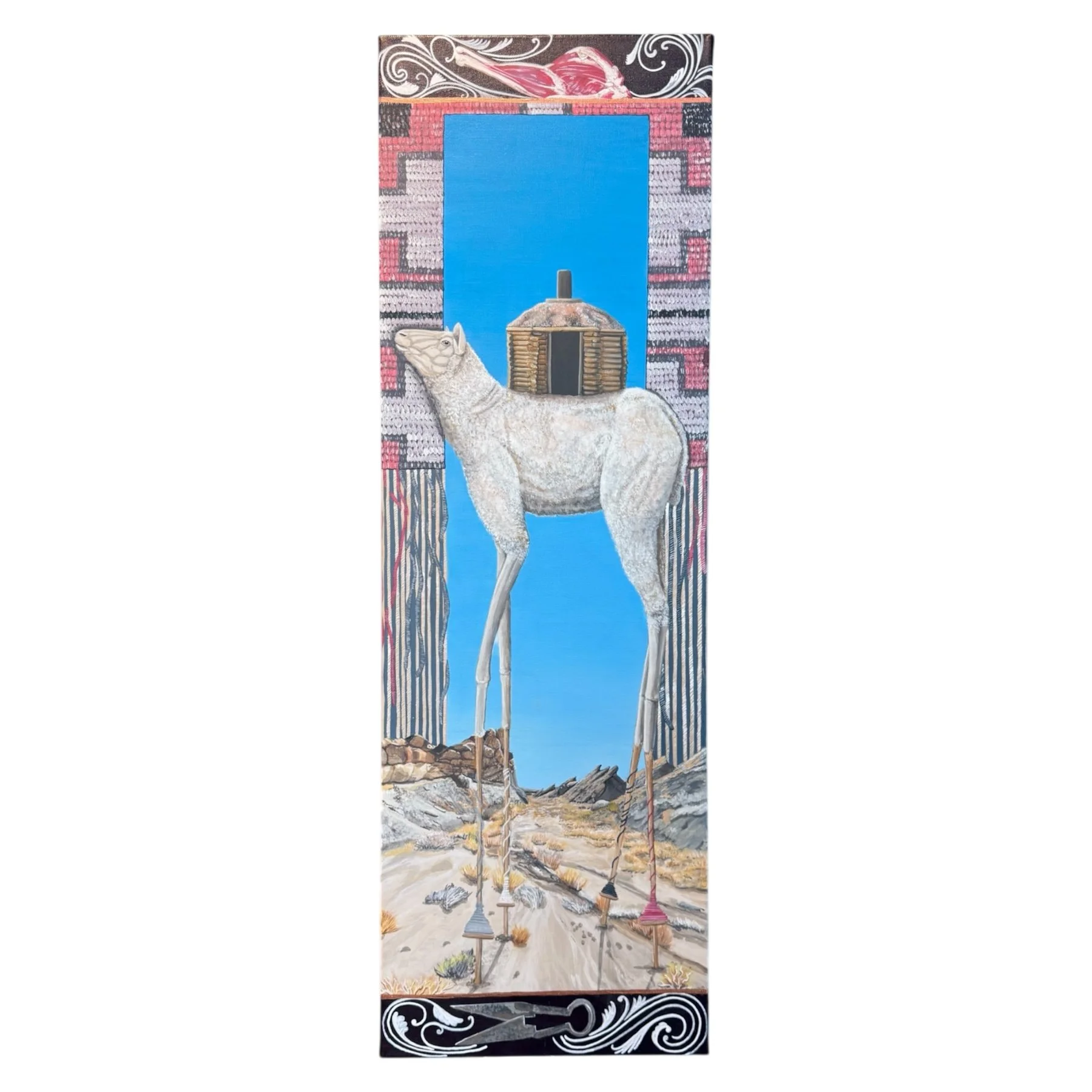
Matthew Bahi, Wool Sheep, 2025, acrylic on canvas
Matthew Bahe’s Wool Sheep (2025) is a striking example of how contemporary Diné painters are reworking tradition through a distinctly modern lens. Bahe draws on Surrealism, using a crisp, uninterrupted blue sky as a stage for layered imagery that feels at once precise and deliberately strange. The result is an image that holds together visually while inviting the viewer to slow down and unpack its many references.
At the center of the painting stands a sheep, already sheared, its pale body set against the desert landscape. Sheep hold deep importance in Diné life as a source of food, wool, and wealth, and Bahe makes that significance explicit. The animal’s legs extend downward and transform into spindles, the tools used to spin wool into yarn. This visual shift links the living animal directly to the labor of weaving and to the textiles for which Diné artists are widely known. That connection is echoed in the woven pattern that frames the upper portion of the painting, reinforcing the cycle from sheep to fiber to finished textile.
Bahe continues to layer meaning through symbolic details. Along the bottom, decorative patterns frame a sheep shearer placed at the center, grounding the work in the physical act of labor. Across the top, similar ornamental elements appear alongside a leg of lamb, a direct reference to sustenance and use. The sheep itself becomes a kind of inventory of value, showing how one animal supports many aspects of life.
Despite the density of imagery, the painting never feels crowded. Bahe’s careful composition and clean, controlled details keep each element legible. His precision allows the work to feel both expansive and balanced, filled from edge to edge without becoming chaotic. Wool Sheep ultimately reads as a thoughtful meditation on interdependence, skillfully blending cultural knowledge, visual storytelling, and a quietly surreal sensibility.
Matthew Bahe’s Wool Sheep (2025) is a striking example of how contemporary Diné painters are reworking tradition through a distinctly modern lens. Bahe draws on Surrealism, using a crisp, uninterrupted blue sky as a stage for layered imagery that feels at once precise and deliberately strange. The result is an image that holds together visually while inviting the viewer to slow down and unpack its many references.
At the center of the painting stands a sheep, already sheared, its pale body set against the desert landscape. Sheep hold deep importance in Diné life as a source of food, wool, and wealth, and Bahe makes that significance explicit. The animal’s legs extend downward and transform into spindles, the tools used to spin wool into yarn. This visual shift links the living animal directly to the labor of weaving and to the textiles for which Diné artists are widely known. That connection is echoed in the woven pattern that frames the upper portion of the painting, reinforcing the cycle from sheep to fiber to finished textile.
Bahe continues to layer meaning through symbolic details. Along the bottom, decorative patterns frame a sheep shearer placed at the center, grounding the work in the physical act of labor. Across the top, similar ornamental elements appear alongside a leg of lamb, a direct reference to sustenance and use. The sheep itself becomes a kind of inventory of value, showing how one animal supports many aspects of life.
Despite the density of imagery, the painting never feels crowded. Bahe’s careful composition and clean, controlled details keep each element legible. His precision allows the work to feel both expansive and balanced, filled from edge to edge without becoming chaotic. Wool Sheep ultimately reads as a thoughtful meditation on interdependence, skillfully blending cultural knowledge, visual storytelling, and a quietly surreal sensibility.